

Every year, the [urban interfaces] organizes a graduate seminar in collaboration with The Netherlands Research school for Media Studies (RMeS). These seminars usually consists of three to four intensive meetings around a specific theme at the intersection of media and urban culture, in which we discuss curated literature, projects, and work on assignments.
Overview of seminars so far:
- 2026-2027: The Learning City: [urban interfaces] graduate seminar 2026-2027 [planned]
- 2025-2026: The Risky City: [urban interfaces] graduate seminar 2025-2026
- 2022-2023: Creative Urban Methods: [urban interfaces] graduate seminar 2022-2023
- 2021-2022: The Magic City: [urban interfaces] graduate seminar 2021-2022
- 2020-2021: Interfacing The (In)Formal City: [urban interfaces] graduate seminar 2020-2021
- 2019-2020: Urban Ecologies: The [urban interfaces] graduate seminar
- 2018-2019: The Right To The City: the [urban interfaces] graduate seminar 2018-2019
- 2017-2018: Urban Friction: the [urban interfaces] graduate seminar 2017-2018
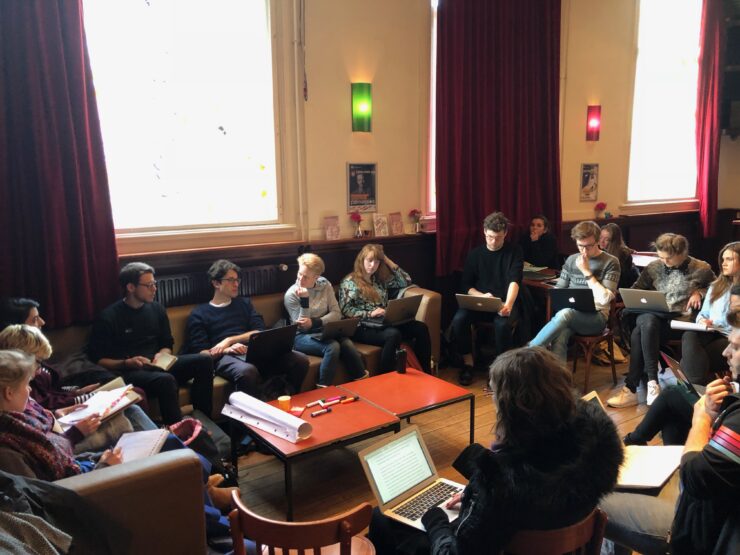

What to expect? Shannon Mattern in her book “A City Is Not a Computer: Other Urban Intelligences” (2021) has written about our approach:
For the past few years Nanna Verhoeff, Michiel de Lange,
and Sigrid Merx of Utrecht University, in collaboration with
a changing cast of art and design collaborators, have hosted a
series of workshops to rethink the urban interface—to interro-
gate urban data sets, the ways they’re traditionally visualized
on interfaces and dashboards, how and where these tools are
deployed, and the political implications of these methodological
and design choices. One year they invited participants to design
dashboards that framed the city as a multispecies ecology, where
humans weren’t the only urban subjects. How might such a
dashboard reveal correlations between, for example, the city’s
waste disposal system and its construction activity and its
rat population, or between energy use, development, and biodiversity?
In another session, participants proposed dashboards
that highlighted people’s “right to the urban commons.” Such
a tool undermined the private property–focused modes of data
collection and representation that prevail today. Participants
were encouraged to produce “critical” interfaces that intro-
duced productive frictions—or what Eric Gordon and Gabriel
Mugar call “meaningful inefficiencies”—that prompted their
users to slow down, to avoid operating on faith or by autopilot,
and to reflect on the biases and limitations of dashboard gover-
nance. Rather than providing slick, seamless user experiences
that purported to offer objective representations of truth, the
Utrecht designers’ work highlighted the partiality, subjectivity,
and politics—and even the deep epistemological and ontological
assumptions—of urban data and their representation.
(Mattern 2021, p. 49)